Two Crates, a Thermos and a Timetable Somebody Still Bothers to Print: A Tuesday Morning With the Van That Stops
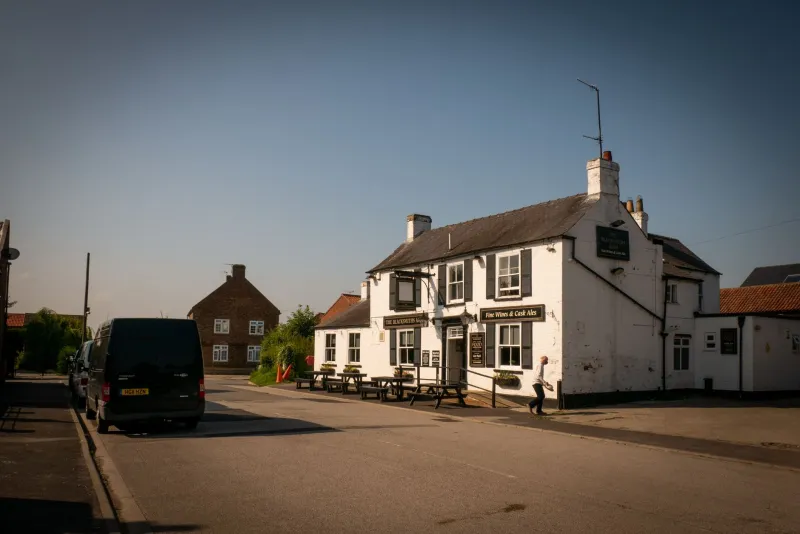
The van pulls into the lay-by behind the village hall at four minutes past nine, which is either late or early depending on which version of the timetable you have committed to memory. Nobody minds. There is a bench, a bin nobody empties and a view of a field that has been mud since October. Four of us are waiting when I arrive. By the time the doors fold open, there are seven.
I have come out for the morning because this route has appeared on a list of things being looked at, and there is a particular sort of tired language that gets wheeled out whenever a service goes on a list. Review. Footfall. Cost per visit. Value for money. I wanted to see the thing itself before deciding how I felt about any of those words, because I have noticed that the people who use quiet services are rarely the people who get asked about them.
Eleven Years of the Same Left Turn
Malc has driven this route for eleven years, which means he knows which farm gates stick, which lane floods, and which of his passengers will want the large print kept back. He does the doors, the stamping, the small talk and, on the evidence of one morning, about four other jobs that were never written into the description.
"It's a social club that happens to have books on it," he says, reversing with the calm of a man who has done it nine hundred times. "That's what nobody puts on the form."
The van itself is not romantic. It smells faintly of diesel and faintly of the carpet, the heating is either furious or absent, and the shelving has been reconfigured so many times that some of the dividers no longer quite meet. But it is warm, it is dry, and it is here, on a Tuesday, which is more than can be said for a lot of things.
Forty Minutes in a Lay-by
The first stop runs long. It always does. A woman called Joyce returns three and takes out four, and tells Malc about her knee in the tone of somebody who has been saving it up. A man in a fleece asks whether there is anything new by an author I have never heard of, and there isn't, and he takes the same book out again with the air of a man settling into a favourite chair. A teenager comes in for something for coursework, finds nothing, and leaves with a thriller instead — the oldest transaction in the history of libraries.
Between them, the talk is not really about books. It is about the bus that stopped running, and the surgery hours that got shorter, and a wedding in the family, and whether the hedge on the corner counts as the council's problem or the farmer's. Somebody brings out a flask. Somebody else produces biscuits. Nobody is in a hurry.
I keep thinking about the phrase 'cost per visit', which is a perfectly reasonable way of counting things and a terrible way of understanding them. If you counted what actually happened in that forty minutes — the advice, the company, the news, the mild argument about the hedge — you would need a different spreadsheet entirely.
What People Actually Borrow
Over the course of the morning, the borrowing is modest. I count fewer than thirty items across four stops. By the standards of a big town library on a Saturday, that is nothing at all.
But the visits are not modest. One stop is a farm track where a man in his eighties lives alone and has done since spring; the van is, by his own cheerful admission, the main event of his week. Another is a cluster of bungalows where three women coordinate their Tuesdays around the arrival, and where one of them has clearly been nominated to remember everybody else's requests.
"You can order anything online," one of them tells me, and then, with the finality of someone who has thought about it properly: "But it doesn't come to you, does it. And it doesn't know your name."
That is the whole argument, really. Not that the van is efficient. It isn't, and pretending otherwise is how these things get lost. The argument is that some things are worth doing badly, or expensively, or for eleven people in a lay-by, because the alternative is a small hole in a place that already has a few.
The Bit Nobody Wants to Say Out Loud
The awkward truth is that these decisions are rarely made by anyone with malice. A budget has to come from somewhere. The number of people using the service is genuinely small. The people who make the case for cutting it are not villains, and the people who make the case for keeping it are not sentimentalists who have never looked at a spreadsheet.
But there is a quietness to services like this that works against them. No protest marches. No petition with forty thousand names. Just a van, a thermos, a timetable printed on card and stuck to a dozen fridges, and a set of people who will not complain loudly because they are, on the whole, quite polite and slightly embarrassed to be asking.
Which is why, I suspect, the timetable on the fridge matters more than it ought to. It is a promise. Somebody has gone to the trouble of printing it, laminating it, and putting it through the door. A week later, here is the van. That is a small thing, and it is entirely the point.
The Return Leg
At the last stop, Malc helps an elderly man down the steps with a hand under the elbow, then stands in the road for a moment watching him get to his gate. It takes a while. Nobody hoots.
Then it is back in, doors shut, and off towards the next village, where I am told there will be a woman waiting who has been coming since 1998 and who once brought the driver a cake. The cake is mentioned three times before we get there, so I assume it was a good one.
I get out at the crossroads and walk back to the car. The van goes on without me, doing its slow, unglamorous, four-minutes-past-nine rounds. It is not a solution to anything, particularly. It is just a thing that shows up, week after week, for people who would otherwise have one fewer thing showing up.
Which, when you put it like that, is not a bad way to spend a Tuesday.