The Kettle Is Not Finished Yet: A Morning in the Church Hall Where Things Get a Second Go
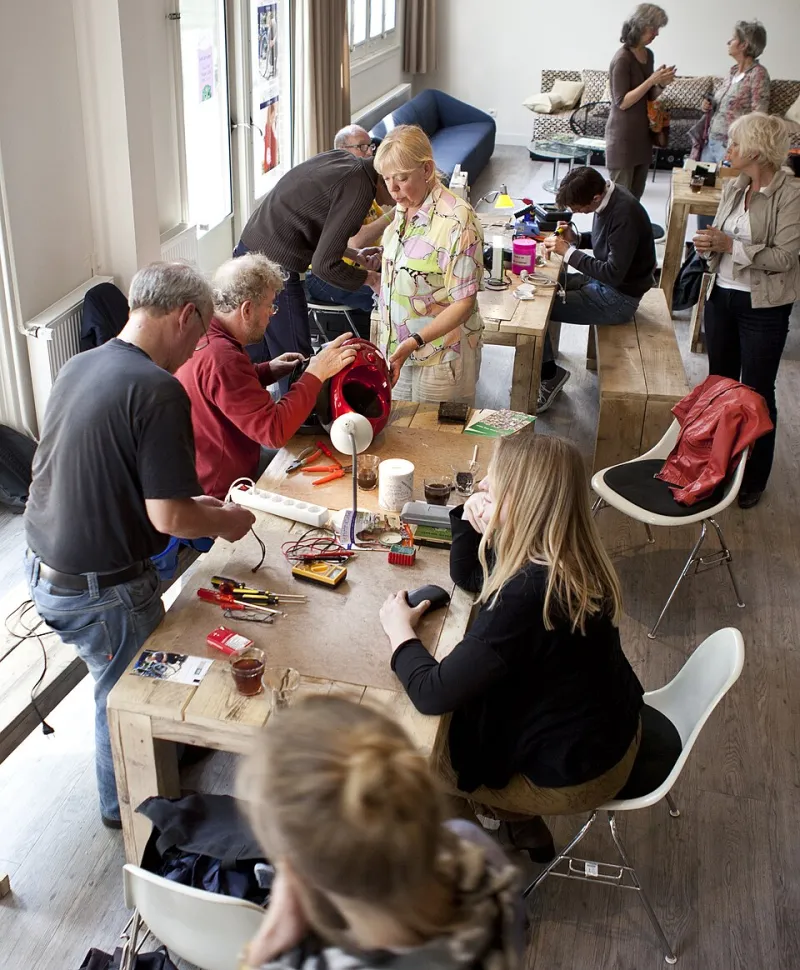
Photo: Ilvy Njiokiktjien, CC BY-SA 3.0, via Wikimedia Commons
At 9.40 on a damp Saturday in November, the queue outside the church hall is already doing that very British thing of pretending not to be a queue. A man holds a kettle like a patient he is not entirely sure is still alive. A woman has a lamp under one arm and a bag of screws in the other. Someone else is carrying a radio that looks old enough to have opinions about the shipping forecast. We shuffle forward, damp coats brushing, and a volunteer with a clipboard asks what we have brought and whether we have booked a slot.
This is a repair café: part surgery, part social club, part quiet protest against the idea that everything is disposable. The format is simple. You bring a broken thing. Volunteers try to fix it. You drink tea, eat a slice of cake, and wait. Nobody promises a miracle. The donation tin sits by the urn, and the whole operation runs on the sort of goodwill that rarely makes the news but keeps a lot of small things alive.
A queue of small disasters
The queue is a catalogue of everyday failure. A toaster that heats one side only. A sewing machine that has jammed mid-hem. A vacuum cleaner that wheezes like an old dog. A bedside lamp with a sentimental provenance and a dodgy switch. None of it is dramatic. That is the point. Most broken things are not dramatic. They are just inconvenient enough to be replaced, and just precious enough to be missed.
The café has been running in this hall since 2022, and the electrical table is the busiest. There is a waiting list for slots — three weeks, apparently — which sounds absurd until you see the queue. People book online, turn up with their broken object, and hope. The volunteers are not magicians. They are retired engineers, keen amateurs, and one man called Martin who has the calm of someone who has seen every fuse known to humankind and is no longer impressed by any of them.
The toaster that would not die
A four-slice toaster is laid on the table with the reverence of a patient being prepped for surgery. It is a wedding present from 1998, the owner says. Only one slot works, and even that one has started to smell faintly of burning. She has already looked at new toasters. They are cheap, she says, and then she says it again in a way that suggests cheap is not really the point.
Martin opens it up, peers inside, and makes a small noise that could mean anything. A broken element. Maybe a connection. He tests, prods, and then says the sentence that has become the unofficial motto of the morning: it is not dead, it is just tired. The part will need ordering. She will come back next month. In the meantime, the toaster goes into a cardboard box with her name on it, and she looks oddly relieved, as though the object has been granted a stay of execution.
That is the thing about repair cafés. They do not always repair. They triage. They listen. They tell you honestly when something is beyond economic repair, or when a safety issue means it really should not go back into your kitchen. But even the failures feel different from throwing something away. A failed repair is a conversation. A bin bag is a full stop.
Tea, solder and the art of hovering
At the next table, a woman called Priya has brought a Roberts radio that belonged to her dad. It works only if you hold the aerial at a particular angle and say nothing. The volunteer opens it up, finds a cracked solder joint, and goes to work with the concentration of a watchmaker. Priya hovers. Everyone hovers. Hovering is the official sport of the repair café. You stand close enough to show you care, far enough away not to be asked to hold a screwdriver.
When the radio crackles into life, she puts a hand to her mouth. It is not a valuable radio. It is not even a particularly good radio. But it was the sound of her dad's kitchen, and for a second the hall goes quiet in the way rooms do when something private happens in public. Then someone asks if anyone wants another brew, and the moment folds back into the morning.
This is the part that the policy documents miss. The right to repair is usually discussed in terms of waste, consumer rights and manufacturing standards. All of that matters. But a repair café also does something less measurable: it turns a broken object into a reason to leave the house. It gives people a table to sit at, a problem to share, and a volunteer who will take their small disaster seriously.
The waiting list is the point
There is a waiting list because repair is popular. That is worth sitting with for a moment. In 2026, we are told constantly that convenience is king, that same-day delivery is the baseline, that anything older than a few years is probably due an upgrade. And yet here are people willingly waiting three weeks for a slot to have a kettle looked at by a stranger in a church hall.
The café is not a solution to the UK's e-waste problem on its own. It is a sticking plaster, and a good one. It shows up the design choices that make repair feel like a hobby rather than a right: glued cases, proprietary screws, parts sold only as whole assemblies, software that refuses to recognise a replacement component. The UK's right-to-repair rules, which arrived in 2021, were a start, but they did not magically open up every appliance. Manufacturers still make choosing repair feel like a small act of defiance.
What a broken thing is really asking for
The volunteers are not saints. They are people who like a problem with a visible edge. They enjoy the moment when a dead thing stirs. They also enjoy the tea, the biscuits and the chance to be useful in a way that does not involve a spreadsheet. There is a social value here that is easy to overlook. The hall is full of men of a certain age who might otherwise be at home, younger people with YouTube confidence and a soldering iron, and children learning that a screwdriver is not a magic wand.
The broken object is an invitation. It says: come in, sit down, tell me how this happened. It gives strangers permission to talk. You can tell a lot about a country from what it does with a broken lamp. We could do worse than make the repair café the default rather than the exception.
I left with a working lamp and a slice of parkin. The lamp was not mine — I had brought it for a neighbour — but I stayed for an hour after it was fixed, watching other people's small disasters get sorted. The kettle on the front table was still waiting. The queue had not shrunk. The tea urn was still going. Nothing about the morning was dramatic, and that was exactly why it felt worth writing down. The kettle is not finished yet. Neither, thankfully, is the idea.