The Town on 87.9 FM: A Saturday Behind the Glass at the Station Above the Chemist
I arrive at twenty to eight on a Saturday morning in November, and the town is still doing that thing where it looks like a film set before the crew turn up. The bakery has its lights on but nobody in it. A bloke in a fleece is hosing down the pavement outside the estate agents. And I am standing at a side door wedged between a chemist and a phone repair shop, pressing a buzzer with a label that has been laminated at least twice.
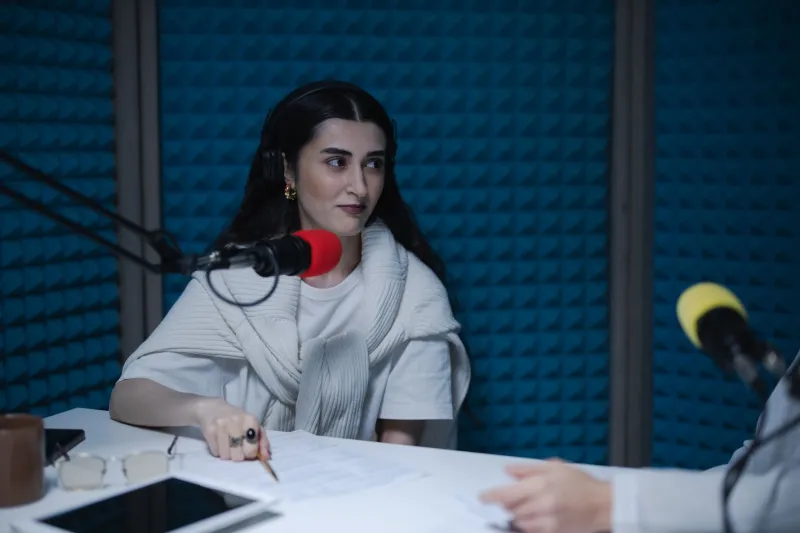
The door clicks open. Two flights up, past a landing stacked with cardboard boxes marked in marker pen — CABLES, DO NOT BIN — is the studio. It is, generously, the size of a decent box bedroom. There is a desk that looks like it came from an office clearance, two microphones on boom arms, a pair of headphones held together with electrical tape, and a window that looks out over the back of the Co-op. It smells, inexplicably, of toast. Nobody on the rota can explain the toast. It has become part of the folklore.
This is what a community radio station actually looks like: not a tower, not a lobby with a branded waterfall, just a room above a shop, a licence held together with good intentions and a small army of people who do it for nothing.
The Clipboard That Runs the Morning
Karen is on the breakfast show and has been since 6am. She is sixty-something, a retired school administrator, and she runs the desk with the calm of someone who has already dealt with far worse than a dead microphone. Next to her sits a clipboard — an actual physical clipboard — on which the morning's running order has been written in biro, with the times in one column and the songs in another. Several entries have been crossed out and rewritten. One has been circled twice and annotated: DON'T — see email from Sandy.
There is a computer, of course. There is always a computer. But the computer's playout software appears to have been designed by someone who actively resents volunteers, so the clipboard is the real system and the screen is what they argue with.
“Right,” says Karen, in the voice of a woman addressing a school assembly. “Weather in three, then the competition, then the travel. If the travel's late we go to the song first. Do not go to the song first unless I say.”
Nobody argues. The travel is, apparently, often late.
The Jingle and the Fear of the Wrong Button
The most beautiful piece of equipment in the room is the jingle. It is roughly four seconds long, features a synthesised brass stab and a voice that was clearly recorded in 1998 by a man standing slightly too far from the microphone, and it says the name of the station with enormous, unearned confidence. It lives in a cart on the playout system. It is triggered by pressing a green button.
The green button is beside the red button. The red button is the cough button, which mutes the mic. On the desk, this arrangement is a permanent joke with a real cost.
“I've done it,” admits Dean, who is twenty-four, does the Thursday evening indie show, and has come in on his day off to help with the phones. “I coughed on air and then apologised with the mic off. Then I coughed again with the mic on. Both coughs went out. Three, actually, if you count the apology.”
He seems fine about it. This is the thing about community radio that no national station can replicate: nobody is going to be fired. There is no shame gauntlet to run. There is just a small red light, a slightly-too-warm room, and the knowledge that the woman who does the flowers at the church might be listening, and she will absolutely mention it in Sainsbury's on Monday.
Dedications and the Woman in Abergavenny
The request line rings at 8:12, which is late. Usually it starts before the town is awake. On the other end is a man named Colin who wants a song for his wife, Lynn, because it is their anniversary, and then spends ninety seconds explaining that they were meant to be in Whitby but the car is in the garage.
Karen takes this down with the pen. She does not hurry him. He is, I realise, not really ringing about the song. He is ringing because someone has answered.
By half past, there is a queue of sorts on Dean's notepad: a birthday for a woman in the next village, a request from a care home where apparently the dining room is set up with a speaker, and a rather lovely call from a woman in Abergavenny who wants a record for her sister, who has just come out of hospital and is listening in bed.
“She's got the radio on the windowsill,” she says. “She can see the car park. It's not much of a view.”
Karen reads the dedication out at twenty to nine, in the same measured voice she used for the school assembly twenty years ago, and then plays the song. It is not a cool song. It is not a song anyone will be writing a think-piece about. Somebody in a bed in Abergavenny, looking at a car park, hears her name on the radio.
That is the whole job, really.
The Weather, Read by a Volunteer
At five past nine, the weather comes in from a man called Gerald, who drives a taxi in the week and does the forecast on Saturdays because, and I quote, “somebody has to.” He stands slightly too close to the microphone, rustles the printed sheet, and delivers a forecast that includes the phrase “bring a coat, but not the big one.”
Karen laughs into the mic. Dean laughs in the corner. Somewhere out there, in a hundred kitchens and a few vans and one bed in Abergavenny, people are getting the same instructions, and adjusting their plans accordingly. Not because it is authoritative. Because it is Gerald, and Gerald drives the number 43 and has never once been wrong about whether you need the big coat.
Why the Wrong Button Sounds Right
There is a school of thought that says local radio is a stepping stone, a training ground, a thing you do until you get somewhere real. Standing in that room, I don't buy it. The amateurism is not a bug. It is the entire texture of the thing. The slightly clipped jingle. The paper running order. The presenter reading a phone number from the back of a food bank leaflet because nobody prepared a script.
The town knows the voices. Not because the voices are brilliant, but because they are known. Lauren on the mid-morning show is the same Lauren who works at the vet's. The bloke doing the Saturday sport round-up once served me a pasty. When they fumble a button — and they all fumble a button — it is not a scandal. It is Tuesday.
By ten, my shift shadowing is over and the next volunteer is coming up the stairs, holding two coffees and a printout of the playlist he wants to argue about. There is a brief, gentle row about whether the new single is too loud for a Saturday morning audience. It is settled by Karen, the clipboard and a compromise nobody loves.
I walk back down past the boxes marked CABLES and out onto the high street, where the bakery now has a queue and the estate agent's window is dry. Somewhere above the chemist, a green light comes on, a synth brass stab plays, and the town is told its own name.
It is not much. It is a room, a rota and a clipboard. But it is the only station in the country that knows about Colin's anniversary, and that's worth the stairs.