Little Trains, Big Hall: A Saturday Among the Model Railway Faithful
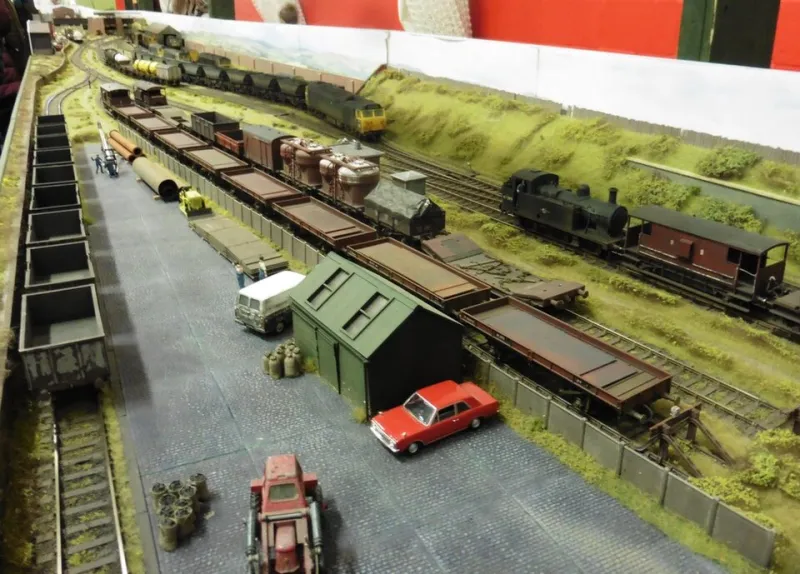
Photo: Roger Cornfoot , CC BY-SA 2.0, via Wikimedia Commons
The hall before the crowds
By 9.40 on Saturday morning, the leisure centre car park was already half full. A man in a fleece carried a wooden box marked FRAGILE: SCENERY. A teenager in a hoodie held a laptop and a plastic takeaway cup. A couple in matching walking jackets compared tickets at the door, as if they were about to see a band rather than a lot of small trains.
Inside, the sports hall smelled of hot bacon rolls and warm transformers. The basketball hoops had been pushed up to the ceiling. The floor was covered in tables, drapes and a hundred miles of imaginary track. A model railway exhibition is a strange thing to walk into cold: all those little worlds, each one lit and humming, each one surrounded by a person who has spent months or years getting it to look almost right.
The first layout I stopped at was a modest OO gauge branch line set somewhere in the West Country. A green diesel shunted a couple of wagons past a signal box. A man in a checked shirt watched it with the intensity of someone waiting for a penalty. Every few seconds he reached over and flicked a switch. The train slowed, stopped, reversed. Nobody clapped. Nobody needed to.
Behind the backscene
Most layouts are not bought. They are accumulated. One builder told me he had been working on his current project since 2019. He had built the baseboards in his garage, wired the points himself and painted the backscene over three winters. The scenery was the part visitors could see. The wiring was the part that kept him up at night.
That seems to be the real divide in this hobby: the people who see a train set and the people who see a system. The train set is the bit on the front of the box. The system is the point motors, the decoders, the isolating sections, the little bits of graphite on the rails. The best layouts are not the ones with the most trains. They are the ones where something unexpected can happen and the operator knows exactly why.
I watched a father explain a turntable to his daughter. She was perhaps six. She asked why the train had to turn round. He said it was because it needed to go back the way it came. She thought about this and said, 'So it is like a bus.' He said yes. It was a very good answer.
Traders and the five-pound box
The trader tables were doing steady business. Secondhand coaches in clear plastic boxes. Packets of people. Tiny bags of flock. A box marked 'odds and sods' for a fiver. One stall had a queue for a locomotive that had been reduced because the box was slightly damaged. The man behind the table said he had sold three of them before lunch.
The economics of the hobby are not small. A new sound-fitted locomotive can cost more than a family's weekly shop. A decent controller is not cheap. The used market is where a lot of people start, and where a lot of people stay. The five-pound rummage box is the gateway drug. You buy a coach with a missing coupling, take it home, fix it, and suddenly you are reading about DCC decoders at midnight.
There were also signs of change. A stall selling 3D-printed lineside huts and station benches. A display of laser-cut baseboard kits. A teenager showing his dad how to programme a sound decoder from an app. The hobby is not stuck in the 1970s, even if some of the layouts are set there. It is full of people who like making things and are quite happy to use a computer to do it.
The teenagers in the corner
You cannot write about model railways in 2026 without mentioning the age question. The cliché is that the hobby is full of men of a certain age and that the average club member has a bus pass. There is some truth in it. There is also a teenage boy in the corner of the hall with a laptop, a headset and a layout that fits in a suitcase.
He was running a small N gauge terminus with a friend. They had built it for a school project and then kept going. They knew the timetable off by heart. They had a queue of people waiting to have a go. When a coupling failed, they fixed it in under a minute. When an older visitor asked how they had done the lighting, the teenager explained it patiently, twice.
That is the bit the cliché misses. The hobby is not dying. It is changing hands. The people who will keep it going are not necessarily the ones who had a train set in 1978. They are the ones who watched a YouTube video about wiring a frog, bought a secondhand controller and turned up on a Saturday morning to see what else was out there.
Why the hall still fills
By early afternoon, the hall was full. Pushchairs. Grandparents. A boy in a football shirt eating a sausage roll. A woman taking photographs of a layout that was clearly modelled on a station she remembered. The trains kept running. The bacon rolls kept selling. A man near the door was handing out leaflets for next month's show in a different town.
A model railway exhibition is a very British sort of crowd. It is quiet, a bit obsessive and quietly generous. People share tips. People lend each other tools. People stand in front of a layout for ten minutes and then say the same thing: 'That's lovely, that.'
In 2026, when so much leisure is solo and screen-shaped, a hall full of little trains is a quiet argument for making things, joining a club and watching something move because you wired it yourself. The trains are small. The point is not.