MDF, Mischief and a Borrowed Armchair: Inside the Tuesday Night Get-In
The first thing you notice is not the castle. It is the smell: hot dust, fresh MDF and the faint ghost of a hundred Thursday bingo nights. The second thing is the noise. Somewhere behind the stage curtains, a man is saying, very calmly, that the left tower is not supposed to lean like that.
It is Tuesday night in a village hall somewhere in the soft middle of England, and the amateur dramatic society is doing the get-in. The show opens on Thursday. Nobody is panicking yet. Give it an hour.
The van that contains everything and nothing
The set arrives in stages. First comes the flat-pack castle, delivered in a stack of boards that look less like scenery and more like a particularly ambitious wardrobe from a Swedish furniture shop. Then comes the borrowed furniture: two armchairs, a standard lamp, a small table with a wobble that has been described in the rehearsal notes as 'characterful'.
A woman in a fleece directs traffic with a mug in one hand and a torch in the other. She is the sort of person every village hall has: the one who knows where the extension leads live, which cupboard hides the good scissors and why the fire door must never, under any circumstances, be propped open with a sandbag.
'That's the throne,' she says, pointing at what appears to be a dining chair with a bit of gold spray paint on it. 'It was the throne last year as well. We just turned the cushion round.'
This is small-town theatre in its purest form. Nothing is wasted. Nothing is quite what it seems. And everything, somehow, is held together by goodwill, gaffer tape and the belief that the audience will be looking at the actors rather than the joinery.
The flat-pack fortress
The castle takes shape slowly. Two people hold a wall panel upright while a third crawls underneath with a cordless drill. There is a brief debate about whether the battlements should face the audience or the back wall. Somebody consult a photograph on their phone. Somebody else says, 'It's a castle, not a Rubik's cube,' which is not technically helpful but does lighten the mood.
I am handed a screwdriver and asked to attach a bracket. I do this badly but with enthusiasm. The bracket holds. The wall does not immediately collapse. In amateur dramatics, this counts as a triumph.
The design is cleverer than it looks. The whole thing is built from MDF panels that fold flat and fit into a trailer. The paint job is deliberately rough, because rough paint reads better under village-hall lighting than a perfect finish. The castle is not meant to be realistic. It is meant to be recognisable, sturdy enough for a quick scene change and light enough that two people can carry it off during the interval.
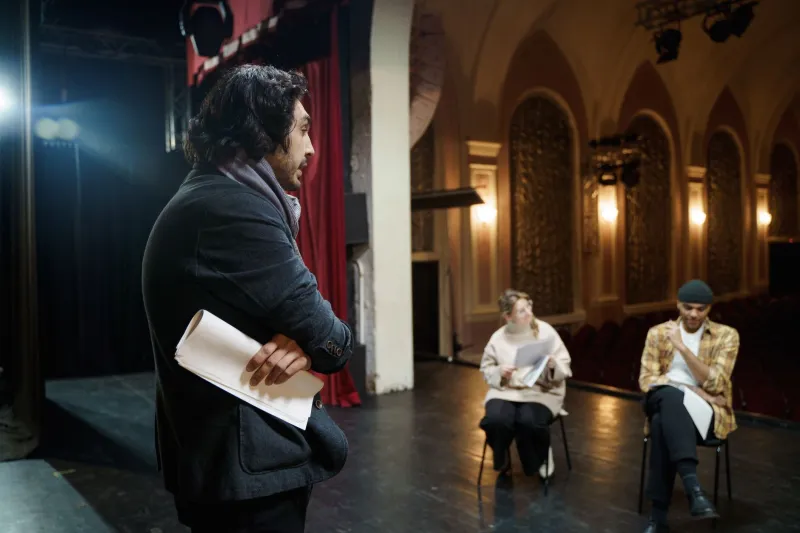
'It's all about the get-in,' says the director, who is wearing a head torch and the expression of a person who has not yet had dinner. 'You can rehearse for six weeks, but the show doesn't really exist until it's in the room. Then you find out what works.'
The lighting rig has opinions
The lighting rig is a temperamental beast. It lives on a metal frame above the audience, held together by clamps, hope and a laminated risk assessment. Tonight it has decided that one of the lanterns will not respond to the desk. This is not unusual. The desk is old, the lantern is older, and the two of them have been feuding for years.
A teenager in a hoodie is sent up a stepladder to investigate. He is the society's unofficial technical director, which means he is the only person who understands the difference between a DMX cable and a kettle lead. He taps the lantern gently, then less gently. It flickers. Everyone cheers. He looks embarrassed, which is the correct response.
There is something lovely about this bit. In a professional theatre, the get-in is a job. Here, it is a social occasion. People bring biscuits. Someone's dad turns up to help lift the heavy bits. A retired teacher is discovered in the wings, painting a papier-mâché rock with the concentration of a Renaissance master.
Why the get-in is the real show
By half nine, the castle is upright, the furniture is placed and the lighting rig is behaving, more or less. The hall still smells of dust and coffee. There is a pile of offcuts by the fire door and a debate about whether the fake ivy should go on the left or the right of the throne.
The cast drift in for a stagger-through. They walk about the set, testing the steps, opening the fake windows, finding out where their voices go. One of them sits on the borrowed armchair and immediately sinks too far back. There is laughter. Somebody adds it to the list.
This is the part the audience never sees. They get the costumes, the lights, the curtain and the applause. They do not get the Tuesday night when a flat-pack castle is dragged into a village hall and a dozen people discover, all over again, that they can make something out of nothing.
And honestly? It is often more entertaining than the show. The dialogue is better, for a start. Nobody has written a line as good as 'the left tower is not supposed to lean like that', and nobody ever will.
If you are near a village hall this week and see a van with a trailer and a man carrying a throne, give them a wave. They are the get-in crew. The show would be nothing without them, even if the castle does lean a bit.