Twenty Minutes of Stillness: The Tuesday Night Drawing Club Beside the Cider Taps
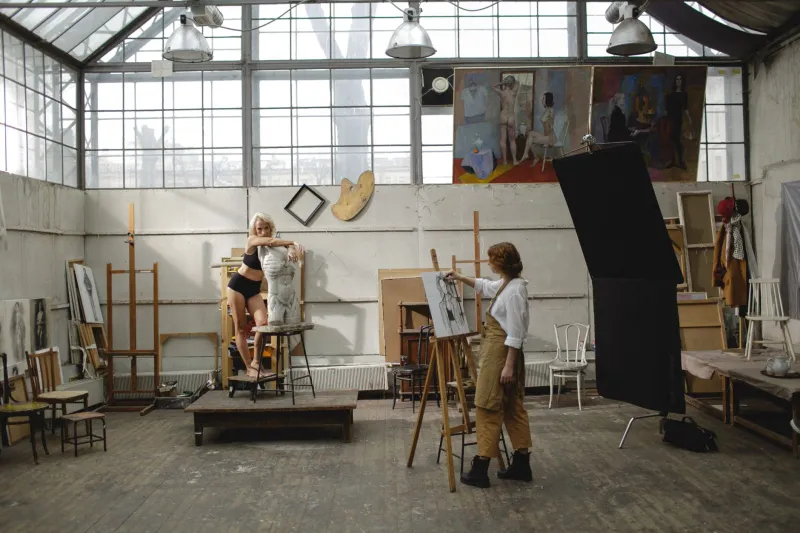
There is a particular smell to a pub back room at ten past seven on a Tuesday. Flat lager, lemon-scented cleaner, and the dry, dusty tang of charcoal sticks being unrolled from a tea towel. I was early. The landlord was still stacking chairs against the wall, and a woman in a paint-flecked fleece was arranging a semicircle of folding chairs with the seriousness of a theatre director blocking a scene.
This is not an art school. There is no tutor, no qualification, no clipboard. There is an honesty box by the fruit machine, a fiver on the table, and a stack of paper that looks like it has been cut down from wallpaper lining. The life drawing club has been meeting here, in one form or another, for years. In 2026 it feels quietly radical.
The rules, such as they are
The format is simple. Two hours, a handful of short poses to warm up, then two longer ones either side of a break. Bring your own materials or borrow a board and a stick of charcoal for a pound. The model gets paid first, the pub gets whatever is left over the bar, and nobody gives a speech.
I had come expecting to feel like an intruder. I cannot draw hands. I cannot really draw anything beyond a convincing potato. But the woman by the door handed me a board, pointed at a folding chair, and said, 'Sit anywhere. We're not precious.' That was the whole induction.
The model is not a prop
Our model is a local regular. She does the Thursday quiz, she knows the bar staff by name, and she has the kind of stillness that makes you realise most people fidget constantly. Before we start, she checks the heater is on, chooses the first pose, and tells us plainly how long she can hold it. There is a robe, a screen, and an unspoken agreement that the room is hers.
That matters more than the drawing. In a back room with a fruit machine humming in the corner, the atmosphere could easily tip into novelty. It does not. The model sets the pace. The regulars respect it. The beginners learn quickly that the point is not to stare, but to look properly.
Beginners and old hands
The room is a strange, quiet mix. A nurse in scrubs who has come straight from a shift. Two teenagers sharing a box of pastels. A man who brings his own drawing board and says almost nothing for two hours. A woman who tells me she has not drawn since school and is clearly delighted to discover that nobody is going to mark her work.
The old hands are not precious either. One of them, a retired teacher with a pencil case held together by an elastic band, spends the break telling me that the trick is to stop trying to make it look like the model and start trying to make it look like a drawing. I am not sure I understand, but I nod as if I do.
The economics of a good Tuesday
A fiver does not go far in 2026. It is less than a pint in most of the pubs I know. But it is enough to pay a model, buy a ream of cheap paper, and keep the lights on in a room that would otherwise be empty on a Tuesday night. The landlord sells tea, crisps and the occasional bag of pork scratchings. Nobody is getting rich. The room is alive.
That is the case for these nights, really. Not that they produce great art, though occasionally they do. Not that they are a substitute for proper tuition, because they are not. It is that they turn a dead room above a pub into somewhere people go to concentrate, quietly, together. In a year when so much of our leisure is delivered through a screen and a subscription, there is something stubbornly good about a room where the only glow is a desk lamp and the only notification is the landlord calling time.
What I took home
My drawings were bad. Not charmingly bad. Bad. The first pose looked like a scarecrow falling over. The second looked like a scarecrow falling over with a hat. But somewhere in the middle of the second hour, I stopped thinking about the result and started thinking about the line. The charcoal made a sound on the paper. The room was silent. Someone's phone buzzed and was immediately silenced. The model held the pose, and the clock above the bar ticked on.
I paid my fiver, folded my paper, and walked out into the cold with black fingertips and a calmer head than I had arrived with. The pub was filling up for the quiz. The easels were already being folded away. It will all happen again next Tuesday, and that is the whole point.