The Jar of Pickled Onions That Changed Hands Three Times: Notes From a Church Hall Tombola
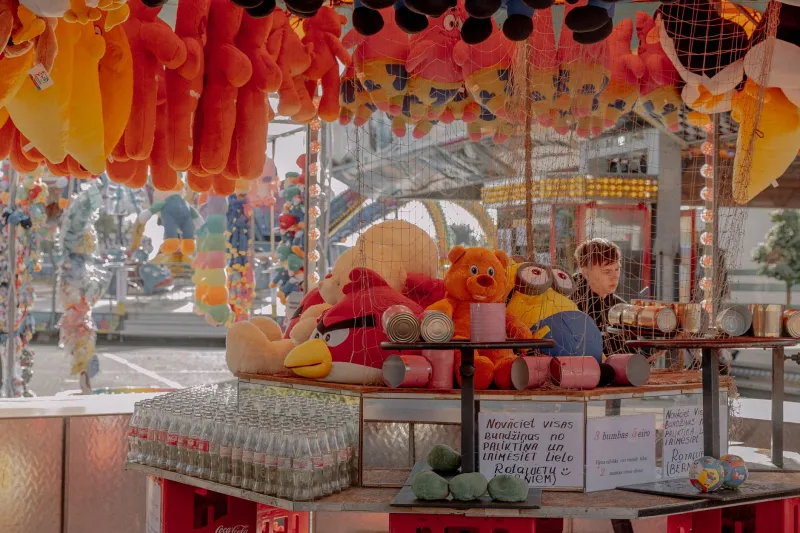
By ten past nine the church hall already smelled of instant coffee, warm mince pies and the faintly medicinal whiff of mulled something that had been kept on a low simmer since dawn. I was behind the tombola table, which is a polite way of saying I was trapped behind six feet of trestle, two biscuit tins of rolled tickets and a prize display that looked like a car boot sale had been curated by a very optimistic vicar.
This was the Saturday Christmas fair, 2026 edition. The same hall, the same sticky floor, the same handwritten sign sellotaped to the wall: TOMBOLA — £1 A STRIP. Someone had drawn a little holly leaf next to it. Someone else had written NO REFUNDS underneath in biro, which felt unnecessarily defensive for a stall where the top prize was a bottle of Baileys and the bottom prize was a jar of pickled onions.
Sorting the loot
The morning shift begins with the prize sort. People donate things. Some donations are thoughtful. Some are clearly the result of a cupboard clear-out at 8am. You get your proper prizes — the Baileys, a box of Roses, a scented candle that has not been lit, a small hamper of biscuits — and then you get the other stuff. A single oven glove. A puzzle of a Highland cow with two pieces missing. A DVD of a film nobody has thought about since 2004. A jar of pickled onions that has, according to the label, been in someone's pantry since the first Tony Blair government.
There is an unwritten hierarchy. The Baileys goes at the back, centre, on a little paper doily, because it is the trophy. The chocolates go next to it. The pickled onions go on the end, where they can be admired from a safe distance. And the oven glove goes wherever it will not immediately fall off the table.
We sorted the prizes into rows and then re-sorted them because someone pointed out that the candle was blocking the view of the biscuits. This is the sort of decision-making that occupies a tombola volunteer for forty minutes. It matters. Presentation is half the battle. The other half is explaining the rules to people who have been playing tombola since before I was born and who still insist on asking how it works.
The roll, the strip and the unwritten rules
Here is the thing about the tombola. It is not complicated. You buy a strip of tickets. You unroll it. If the number ends in a five or a zero, you win a prize. That is it. That is the whole game. And yet every year, without fail, someone will approach the table with the wary expression of a person defusing a bomb and say, So how does this work, then?
You explain. They nod. They buy a strip. They unroll it slowly, like they are reading a telegram from the front line. They get three numbers ending in seven. They look at you as if you have personally arranged for them to lose. Then they buy another strip.
The unwritten rules are the best part. You must not peek at the roll before you buy it. You must not swap strips with the person next to you. You must not ask for a specific prize, although everyone does. And you must never, ever announce that you are just doing it for the kids while buying six strips for yourself. We know. We have seen it before.
There is also the matter of the lucky dip. We do not have a lucky dip. We have never had a lucky dip. But at least four people asked me where the lucky dip was, as if it had been a fixture of the fair since 1974 and I had personally removed it out of spite. I pointed them towards the cake stall. They seemed satisfied.
The punters
What I love about running a tombola is that you get to meet the whole town in about four hours. You get the nan who buys a strip for every grandchild and then keeps the prizes in her bag for later. You get the dad who wins the Baileys and does a little fist-pump before remembering he is a grown man in a church hall. You get the teenager who wins the Highland cow puzzle and looks at it like it is a summons.
And then you get the woman who wins four times in a row. There is always one. She buys a strip, wins a box of Roses. She buys another, wins a candle. She buys a third, wins the pickled onions. By the fourth win she is apologising to the queue behind her, but you can tell she is enjoying it. The queue, to be fair, is enjoying it too. There is something deeply satisfying about watching someone else have a lucky streak, as long as it is not the person who just won the Baileys.
The pickled onions, incidentally, changed hands three times that morning. First they were won by a man who said, I don't even like onions. Then they were donated back to the table by his wife, who said, He'll never eat them. Then they were won by a small boy who seemed genuinely thrilled, possibly because he thought they were a sort of treasure. His mother's face suggested otherwise. The onions ended up back on the table by lunchtime, like a boomerang with a best-before date.
What the prize table tells you
A tombola prize table is a portrait of a town. It tells you what people are prepared to give away. It tells you what they think is worth winning. It tells you that someone, somewhere, believes a single oven glove is a suitable Christmas gift. And it tells you that the same town will always turn up, pound coins in hand, ready to have a go.
The generosity is real, even when the prizes are odd. The Baileys was donated by a woman who won it at last year's fair and does not drink it. The chocolates came from a family who bought too many in the Boxing Day sales. The pickled onions were clearly a regift, but they were a regift with a story, and by the end of the day the story was better than the onions.
There is thrift here, too. Nobody pretends the tombola is a goldmine. After paying for the hall, the tea urn and the mince pies, the profit is modest. But it is profit. It goes towards the roof fund, or the food bank, or the new kettle in the kitchen that actually boils water in under ten minutes. In 2026, with everything costing what it costs, a pound a strip is still a cheap afternoon out.
And there is humour. The whole stall runs on it. The jokes about the pickled onions. The mock outrage when someone wins the Baileys. The handwritten signs. The way somebody always says, Ooh, I've won a thing as if they have discovered a new continent rather than a box of shortbread.
By four o'clock the prizes were mostly gone, the floor was covered in ticket stubs and the tea urn was making that noise it makes when it wants to be switched off. We packed the leftover pickled onions into a carrier bag and put them in the cupboard for next year. Somebody said, They'll keep. Somebody else said, They've kept this long.
And that, really, is the tombola. A pound a strip, a hoarded bottle of Baileys, a jar of onions that refuses to leave. It is not glamorous. It is not efficient. But it is one of the most honest rituals of local life, and I would do it again next Saturday if somebody asked.
I just would not put the candle in front of the biscuits.